Peptide Information
Peptide Purity Testing: Labs, Costs & How to Verify (2026)
By NUPEPS Research TeamMarch 22, 2026
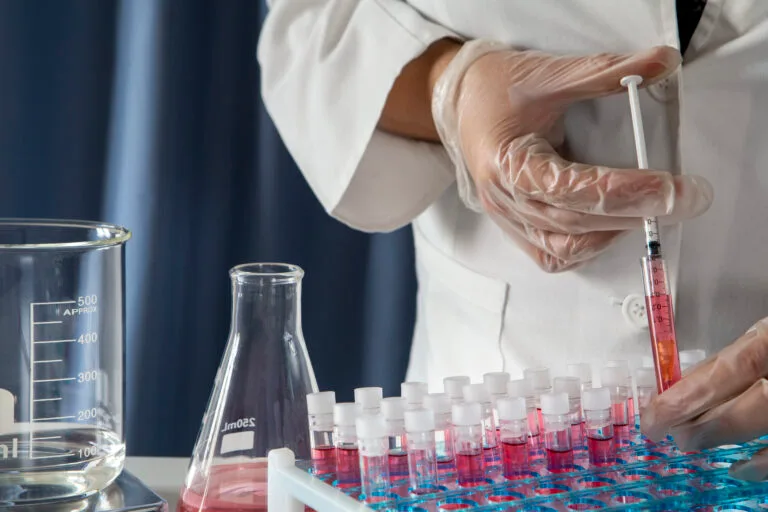
Peptide purity testing is the independent laboratory analysis of a research peptide sample. A testing lab confirms three things: identity (the material is the peptide it claims to be), purity (how much of the sample is that peptide), and content (how many milligrams are actually in the vial).
Independent peptide testing typically costs $150–$450 per vial for purity and identity at the laboratories that publish prices, with results in two business days to two weeks depending on the lab. Endotoxin and sterility screening cost extra. Every laboratory in the comparison below accepts samples by mail.
All peptides discussed on this page are research materials. Testing verifies what a sample is; it does not make any material approved, safe, or suitable for human use.
Which peptide testing labs can test a sample?
The laboratories below are the independent labs most often used for research peptide analysis. They differ in location, methods, published pricing, turnaround, and — most importantly for verification — whether anyone can look a report up on the lab's own website afterwards.
| Lab | Location | What it tests | Purity + identity price | Turnaround | Verify a report online? |
|---|---|---|---|---|---|
| Janoshik Analytical | Prague, Czech Republic | HPLC purity, mass spectrometry identity, quantity per vial; endotoxin, sterility and heavy metals as add-ons | $215–$450, by compound | ≈5–7 business days | Yes — task number + unique key, or QR code |
| Freedom Diagnostics Testing | Franklin, TN, USA | HPLC purity and LC-MS identity on every certificate; net content, endotoxin, sterility and heavy metals available | $200 (net content +$25) | 2–4 business days | Yes — public lookup by accession number |
| MZ Biolabs | Tucson, AZ, USA | HPLC-UV purity with mass spectrometry identity; quantification of powders and formulated products | $175–$350 (no published rate card) | ~1–3 weeks | No public lookup — reports go to the submitting client |
| Chromate | USA | HPLC qualitative and quantitative analysis per compound; endotoxin and sterility testing | $180–$380, by compound | Not published | Yes — results issued through its Verify portal |
| Vanguard Laboratory | Olympia, WA, USA | HPLC purity and identity; quantity packages; endotoxin, sterility and heavy metals as add-ons | $200 ($250 with quantity) | 3–5 business days | Yes — "Verified by Vanguard" portal |
| Peptide Test | Michigan, USA | Purity and mass (quantity) testing; endotoxin, sterility and heavy metals as add-ons | $200–$400, by compound | Not published | Yes — lookup by sample number |
| ILS Laboratories | San Diego, CA, USA | Full QC panel: HPLC purity and quantitation, identity, endotoxin, heavy metals, rapid sterility screen | $200 HPLC panel; $600 full QC panel | ~1 week (rush: 3 business days) | Yes — QR-verified certificates |
| Colmaric Analyticals | St. Petersburg, FL, USA | Contract laboratory: HPLC purity, mass spectrometry identity, amino acid analysis | Not published — quote-based | Varies by contract | No public portal documented |
Prices are each laboratory's published figures as of November 2026 and change without notice; confirm on the lab's own site before shipping a sample. Two patterns matter more than any single price: whether identity is confirmed by mass spectrometry or by a weaker retention-time match, and whether the finished report can be verified independently.
Janoshik Analytical (Prague, Czech Republic)
Janoshik is the laboratory most frequently named on peptide certificates of analysis. Its base analysis reports identity, amount per vial and HPLC purity together, priced per compound at $215, $290 or $450. Reports carry a task number and a unique key that anyone can check on the lab's verification page.
Freedom Diagnostics Testing (Franklin, Tennessee, USA)
Freedom Diagnostics pairs HPLC purity with LC-MS identity on every certificate — never one without the other — for a published $200, with net peptide content for $25 more. Its stated turnaround of two to four business days is the fastest in this comparison, and certificates are searchable in a public database by accession number.
MZ Biolabs (Tucson, Arizona, USA)
MZ Biolabs is a US DEA Schedule III licensed facility running HPLC with UV detection alongside mass spectrometry, oriented mainly toward manufacturers and commercial clients. It publishes no rate card; its own posted pricing has listed peptide identity and purity at $175, with quantification at $250. Purity testing there does not include sterility or endotoxin.
Chromate (USA)
Chromate publishes a per-compound price list for HPLC analysis, with most research peptides between $180 and $380, endotoxin and sterility testing at $240 each, and additional vials from the same batch at $50. Results are delivered through the Verify portal at the top of its site, so a report can be checked after issue.
Vanguard Laboratory (Olympia, Washington, USA)
Vanguard's purity and identity test costs $200 per vial and confirms identity by retention time and UV spectrum against a reference standard; packages with quantity start at $250, and LC-MS identity is quoted separately. Endotoxin ($210), sterility ($150) and heavy metals ($150) are published add-ons, and reports check through its Verified by Vanguard portal.
Peptide Test (Michigan, USA)
Peptide Test sells purity and mass testing per compound through an online storefront: common peptides start at $200, with larger or specialty compounds up to $400. Endotoxin testing starts at $300, sterility is $300, and heavy metals start at $500. Reports can be looked up afterwards by sample number on its verification site.
ILS Laboratories (San Diego, California, USA)
ILS offers a $200 HPLC panel covering identity, purity and quantitation, and a $600 Full QC Panel that adds endotoxin, heavy metals and a rapid sterility screen, at roughly one week. One nuance: standard identity confirmation is HPLC retention-time matching against reference standards; LC-MS identity is a custom add-on. Certificates are QR-verified.
Colmaric Analyticals (St. Petersburg, Florida, USA)
Colmaric is an ISO/IEC 17025 accredited contract laboratory serving manufacturers and distributors rather than individual submitters, with HPLC purity, mass spectrometry identity and amino acid analysis among its peptide services. Engagements are quote-based — it publishes neither prices nor turnaround — and no public report-verification portal is documented.
How much does peptide testing cost?
At the laboratories that publish prices, purity and identity for one vial runs about $150 to $450. The spread is mostly the compound: common peptides sit at the low end, while large or complex molecules cost more to analyze. Quantity (net content) is included by some labs and a small add-on at others.
Contamination screening is priced separately almost everywhere. Endotoxin testing adds roughly $150 to $300, sterility $150 to $300, and heavy metals $100 to $500 depending on the lab. Sending additional vials from the same batch, each reported separately, typically adds $50 to $135 per vial — the correct way to test a batch rather than a single vial.
What does peptide purity testing actually verify?
A complete peptide analysis answers three separate questions, and a report that answers only one or two of them leaves the rest open. Identity asks whether the material is the peptide named on the label. Purity asks how much of the sample that peptide accounts for. Content asks how much peptide, by weight, the vial actually holds.
- Identity — is this the claimed peptide? (mass spectrometry, or a stated alternative)
- Purity — how much of the sample is that peptide? (HPLC)
- Content — how much peptide by weight is in the vial? (quantitative assay)
What is peptide identity testing?
Peptide identity testing confirms that the material in a vial is the peptide it is claimed to be — that its molecular structure matches the intended amino acid sequence. It answers a different question from purity testing: purity asks how much of the sample is the main component, while identity asks what that component actually is.
Identity is normally confirmed by mass spectrometry. The instrument measures the mass-to-charge ratio of the peptide's ions and calculates its molecular weight, which is compared with the theoretical weight of the claimed sequence. A match within tolerance supports the identification; tandem mass spectrometry (MS/MS) goes further, fragmenting the peptide and reading pieces of the sequence itself.
The distinction matters because an HPLC chromatogram cannot identify what it separates. A purity result of 99% states that 99% of the detected peak area belongs to one component — it does not prove that component is the peptide on the label. Some laboratories instead confirm identity by HPLC retention-time matching against a reference standard, which is a weaker check and should be read as such on a report.
HPLC vs. mass spectrometry vs. amino acid analysis: what does each method prove?
Peptide analytical testing relies on complementary methods, because no single technique answers every quality question. Understanding what each method proves — and what it cannot prove — is the key to reading any peptide lab report, whichever laboratory issued it.
HPLC proves the purity profile: it separates the components of a mixture and measures each peak, producing the purity percentage quoted on most reports. It cannot prove the identity of the main peak, or the absolute quantity of peptide present. A purity figure without an identity result is a number attached to an unnamed substance.
Mass spectrometry (LC-MS) proves identity: by measuring molecular weight — and, in MS/MS mode, sequence fragments — it confirms the separated material is the peptide it is claimed to be. It cannot, on its own, prove the purity percentage or how much peptide a vial contains; it is an identification tool, not a complete assay.
Amino acid analysis proves composition and quantity: the peptide is broken into its amino acids and measured against standards, confirming the composition and giving the net peptide content. It cannot prove the order of the sequence or the purity profile; it reports the building blocks, not the assembled structure.
What does a peptide lab report contain?
A peptide lab report — usually issued as a certificate of analysis (COA) — ties one specific batch of material to specific test results. A complete report contains enough information for the reader to check the results, and to check the report itself, as follows:
- The issuing laboratory's name and contact details
- A unique report or certificate ID
- The product name, exactly as sold
- The batch or lot number tested
- The date of testing
- The methods used (for example, HPLC for purity, mass spectrometry for identity)
- The purity result, with the chromatogram it was calculated from
- The identity result, stating theoretical and observed molecular weight
- Net peptide content, where measured
- An analyst's or authorised signatory's name or signature
Results apply only to the batch named on the report. Peptide batch testing means the sample analyzed came from the same production batch as the product in hand — which is why the batch or lot number on the vial and on the report must match exactly before any result means anything.
How can you verify a peptide lab report?
Peptide lab reports can be verified directly with the laboratory that issued them. First, match the batch or lot number printed on the product label to the batch number on the report — the two must be identical, because results apply to that batch only. A report offered for a different batch, or for no batch, verifies nothing.
Then use the report's own identifiers. Many laboratories provide a verification portal: a task number and key, an accession number, a sample number, or a QR code printed on the document that resolves to the laboratory's own confirmation page. Where no portal exists, the report ID and batch number can be quoted to the laboratory directly; an issuing laboratory should confirm that it tested that batch and that the document matches its records.
NUPEPS PEPTIDES publishes the certificates for its own catalog on its COA library, each tied to the batch it covers, so the batch number on a vial can be matched against the certificate before the material is used in research. The full range is collected in our research peptide catalog.
How do you verify peptide purity in practice?
Verifying peptide purity means checking the claim, not just reading it. Confirm the purity percentage comes from a stated HPLC method and is supported by the chromatogram on the same document. Confirm identity was tested for the same batch, so the purity figure is attached to the right compound. Confirm the batch number matches the product in hand, and confirm the report with the issuing laboratory as described above.
Is third-party testing different from in-house testing?
In-house testing is performed by the manufacturer or seller's own laboratory as part of production quality control. It is fast, and it can be applied to every batch, but the party grading the product is the party selling it. Third-party testing is performed by an independent laboratory with no stake in the sale, like the laboratories compared above.
Because an independent laboratory can be contacted directly and has no interest in the outcome, a third-party report carries a different weight from an internal one. In practice, rigorous suppliers combine both: in-house checks during production, and independent third-party confirmation of identity and purity for each batch released for research use.
What are the red flags in a peptide lab report?
- No batch or lot number, so the results cannot be tied to any specific material
- The same report offered for multiple batches or products
- A purity claim with no method named and no chromatogram shown
- No identity result — purity asserted for an unnamed substance
- A product name, strength or form on the report that does not match the product sold
- A test date earlier than the batch it supposedly covers
- An issuing laboratory with no verifiable identity, or one that will not confirm its reports
- Perfect results repeated identically across batches, with no underlying data
None of these signs requires specialist knowledge to spot. They are document checks, and they are the difference between peptides that are genuinely purity tested and peptides that are merely described that way.
Frequently asked questions
What is peptide purity testing?
Peptide purity testing is laboratory analysis of a peptide sample, usually by HPLC, that measures what fraction of the sample is the intended peptide. A complete analysis also confirms identity — normally by mass spectrometry — and net content, so the purity figure is attached to the right compound in a known quantity.
How much does it cost to get a peptide tested?
Purity and identity for one vial costs about $150 to $450 at the laboratories that publish prices, depending on the compound and the lab. Endotoxin adds roughly $150 to $300 and sterility $150 to $300. Extra vials from the same batch, each reported separately, typically add $50 to $135 per vial.
Which peptide testing labs accept samples by mail?
All eight laboratories compared on this page accept samples by mail, including from individual researchers in most cases. US-based options include Freedom Diagnostics Testing (Tennessee), MZ Biolabs (Arizona), ILS Laboratories (California), Vanguard Laboratory (Washington), Colmaric Analyticals (Florida) and Peptide Test (Michigan); Janoshik Analytical operates from the Czech Republic.
What is peptide batch testing?
Peptide batch testing means testing a sample drawn from a specific production batch, with the result tied to that batch's lot number. It is the only form of testing that says anything about the vial in hand: the lot number on the product and on the lab report must match for the result to apply.
How long does peptide analysis take?
Turnaround ranges from two to four business days at the fastest laboratory in this comparison to roughly three weeks at the slowest, with most labs reporting in about one week. Culture-based sterility testing, where offered, adds time that cannot be shortened. Shipping time to and from the laboratory is additional.
How do I verify a peptide lab report?
Match the batch or lot number on the report to the product, then check the report with the issuing laboratory: enter its task number, accession number, sample number or QR code on the lab's own verification page where one exists, or quote the report ID to the laboratory directly. If the laboratory cannot confirm it, the document carries no weight.
Is there a peptide testing kit I can use at home?
No home kit can measure peptide purity or identity; those measurements require HPLC and mass spectrometry instruments. Products sold as testing kits are either mail-in services for the laboratories above or reagent tests that detect a single contaminant class. To test a peptide, mail one unopened vial to a laboratory.
Frequently asked questions
What is peptide purity testing?
Peptide purity testing is laboratory analysis of a peptide sample, usually by HPLC, that measures what fraction of the sample is the intended peptide. A complete analysis also confirms identity — normally by mass spectrometry — and net content, so the purity figure is attached to the right compound in a known quantity.
How much does it cost to get a peptide tested?
Purity and identity for one vial costs about $150 to $450 at the laboratories that publish prices, depending on the compound and the lab. Endotoxin adds roughly $150 to $300 and sterility $150 to $300. Extra vials from the same batch, each reported separately, typically add $50 to $135 per vial.
Which peptide testing labs accept samples by mail?
All nine laboratories compared in the guide accept samples by mail. US-based options include Freedom Diagnostics Testing (Tennessee), MZ Biolabs (Arizona), ILS Laboratories and KMD Analytical (California), Vanguard Laboratory (Washington), Colmaric Analyticals (Florida) and Peptide Test (Michigan); Janoshik Analytical operates from the Czech Republic.
What is peptide batch testing?
Peptide batch testing means testing a sample drawn from a specific production batch, with the result tied to that batch’s lot number. It is the only form of testing that says anything about the vial in hand: the lot number on the product and on the lab report must match for the result to apply.
How long does peptide analysis take?
Turnaround ranges from two to four business days at the fastest laboratory in the comparison to roughly three weeks at the slowest, with most labs reporting in about one week. Culture-based sterility testing, where offered, adds time, and shipping time to and from the laboratory is additional.
How do I verify a peptide lab report?
Match the batch or lot number on the report to the product, then check the report with the issuing laboratory: enter its task number, accession number, sample number or QR code on the lab’s own verification page where one exists, or quote the report ID to the laboratory directly. If the laboratory cannot confirm it, the document carries no weight.
Is there a peptide testing kit I can use at home?
No home kit can measure peptide purity or identity; those measurements require HPLC and mass spectrometry instruments. Products sold as testing kits are either mail-in services for the laboratories compared in the guide or reagent tests that detect a single contaminant class.
All products are intended strictly for laboratory research and in-vitro use only. Not for human or veterinary consumption, diagnostic, or therapeutic use. Products are not drugs, foods, cosmetics, or dietary supplements and may not be misbranded, misused, or mislabeled.