Research Guides
What Is HCG? Glycoprotein Hormone Research Guide
By NUPEPS Research TeamNovember 15, 2026
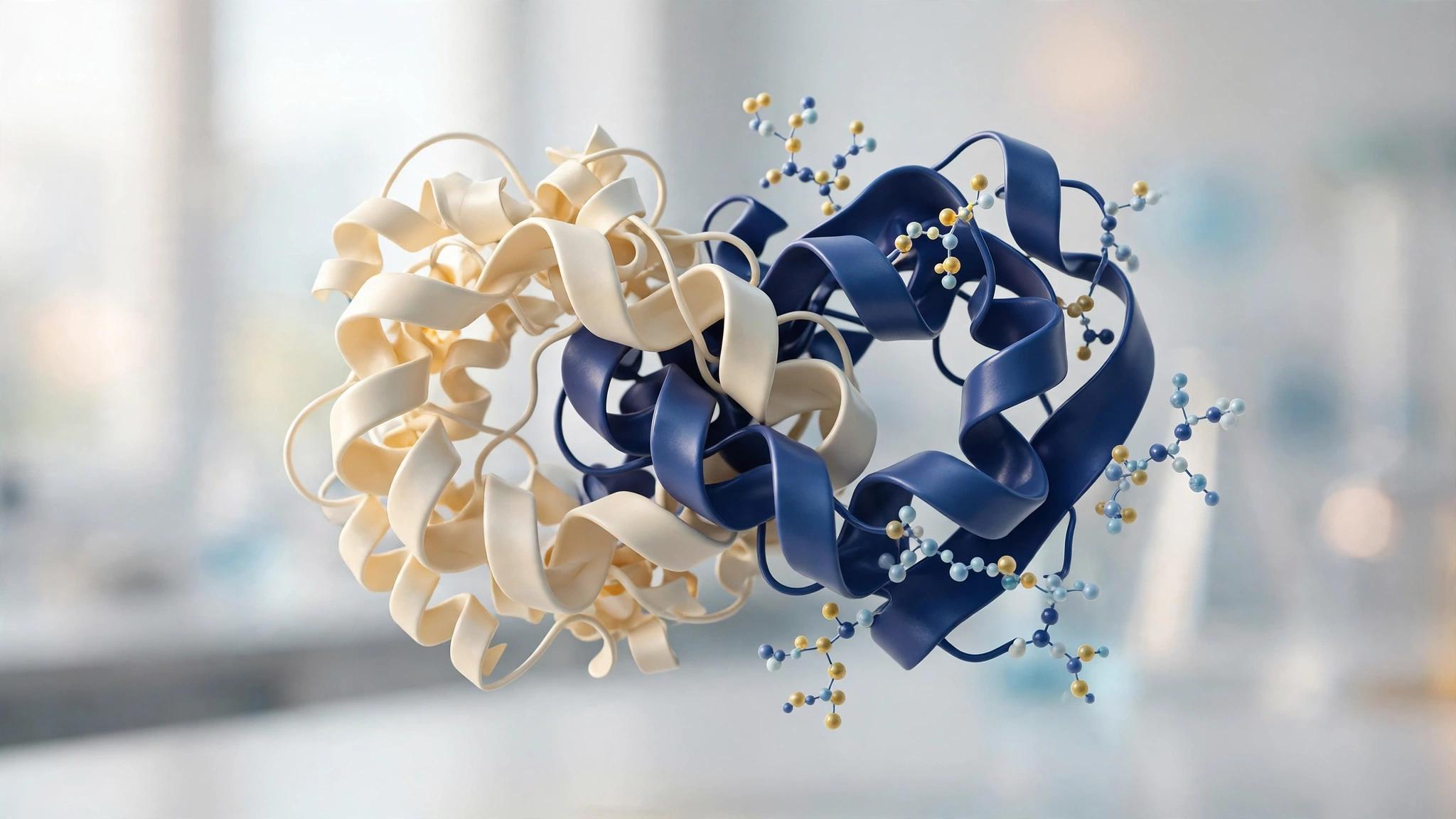
Human chorionic gonadotropin, called HCG, is a glycoprotein hormone built from two different subunits joined together: a 92-amino-acid alpha subunit shared with three other hormones, and a 145-amino-acid beta subunit found only in HCG. Together the 237-amino-acid hormone activates the luteinizing hormone receptor, and that single receptor relationship explains almost everything in its research record.
HCG is produced by the placenta in early pregnancy, and its detection is the basis of standard pregnancy testing. In the laboratory it is a different kind of tool from the small synthetic peptides around it in a catalog: a large, sugar-carrying protein hormone whose identity depends on two subunits and their glycosylation, not on one short sequence. This guide reviews what HCG is, how it signals, what the research record covers, and how laboratories verify the material.
What Is HCG, Exactly?
HCG is a heterodimer: two unlike protein chains held together by non-covalent forces rather than by a chemical bond between them. Neither subunit is the hormone on its own. The assembled pair is the biologically active molecule, and the beta subunit's unique tail is what separates HCG from luteinizing hormone, the pituitary hormone it so closely resembles.
- Full name: Human chorionic gonadotropin
- Structure: Two non-covalently joined subunits, alpha and beta
- Alpha subunit: 92 amino acids, identical to the alpha subunit of LH, FSH, and TSH
- Beta subunit: 145 amino acids, unique to HCG, with a serine-rich C-terminal extension carrying four O-linked sugar chains
- Total length: 237 amino acids across both subunits
- Molecular weight: Approximately 36.7 kDa, roughly one third of it carbohydrate
- CAS number: 9002-61-3
- Receptor: The LH/HCG receptor (LHCGR), a G-protein-coupled receptor
- Natural source: Placental trophoblast tissue in early pregnancy
The sugar chains are not decoration. HCG carries eight glycosylation sites across its two subunits, and that carbohydrate coat is a large part of why the hormone circulates far longer than LH despite acting on the same receptor. Glycosylation is also why HCG exists as a family of related forms rather than one perfectly uniform molecule.
Where Does HCG Come From?
HCG was identified in the 1920s through its presence in pregnancy, and its two subunit sequences were worked out in the 1970s, establishing the shared-alpha, unique-beta architecture that defines the whole glycoprotein hormone family. The placenta's syncytiotrophoblast produces HCG from the first days after implantation, and its earliest known role is maintaining the corpus luteum so progesterone production continues.
Citation: Morgan FJ, Birken S, Canfield RE. The amino acid sequence of human chorionic gonadotropin. The alpha subunit and beta subunit. Journal of Biological Chemistry. 1975. [PubMed PMID: 1150658](https://pubmed.ncbi.nlm.nih.gov/1150658/)
Citation: Pierce JG, Parsons TF. Glycoprotein hormones: structure and function. Annual Review of Biochemistry. 1981.
That family structure matters for research design. Because the alpha subunit is identical across HCG, LH, FSH, and TSH, any assay or experiment that reads the alpha subunit alone cannot tell those hormones apart. Specificity for HCG always comes from the beta subunit, which is why beta-directed antibodies are the working parts of HCG detection.
How Does HCG Signal Through the LH/HCG Receptor?
HCG binds the LH/HCG receptor on gonadal cells, the same receptor luteinizing hormone uses. Receptor activation raises cyclic AMP inside the cell and drives steroid hormone production in the tissues that carry the receptor, which is the pathway behind HCG's roles in both ovarian and testicular experimental models.
The difference between HCG and LH at that shared receptor is duration, not direction. LH is released in pulses and cleared quickly, while HCG's heavily glycosylated beta tail — the extension LH does not have — keeps it in circulation far longer. In experimental terms, HCG behaves as a long-acting stand-in for LH at the same receptor, and most of its laboratory uses follow from that one property.
HCG's forms complicate the picture usefully. Alongside the intact hormone, biological samples contain free beta subunit, nicked forms, and a beta-core fragment, and different assays detect different members of that family. A researcher who does not know which form a measurement refers to can misread an otherwise careful experiment.
How Do HCG and LH Compare?
| Feature | HCG | LH |
|---|---|---|
| Full name | Human chorionic gonadotropin | Luteinizing hormone |
| Source | Placenta, in pregnancy | Anterior pituitary |
| Alpha subunit | 92 amino acids | 92 amino acids, identical |
| Beta subunit | 145 amino acids, with a glycosylated C-terminal extension | 121 amino acids, no equivalent extension |
| Receptor | LH/HCG receptor (LHCGR) | LH/HCG receptor (LHCGR) |
| Circulation pattern | Long-lived, sustained | Pulsatile, short-lived |
| Detection role | The analyte standard pregnancy tests measure | Measured in fertility and endocrine panels |
The table captures why the two are so often mentioned together and so easily confused. Same receptor, same alpha subunit, near-identical beta cores — and then one extension on the HCG beta subunit changes the hormone's lifespan and its entire practical role, from a pituitary pulse signal into a sustained placental one.
What Has the Published Research Covered?
HCG's research record is older and more clinical than most catalog compounds, because regulated pharmaceutical forms of the hormone have existed for decades. In reproductive research, HCG is the standard tool for triggering final egg maturation in assisted-reproduction studies, precisely because its long action at the LH receptor can stand in for the natural LH surge in a controlled protocol.
In male endocrine research, HCG has been used to probe how the testis responds when pituitary gonadotropins are suppressed. In one frequently cited study design, researchers used HCG in men whose own gonadotropin output was experimentally suppressed and measured intratesticular testosterone, showing the gonadal axis could be interrogated independently of the pituitary signal.
Citation: Coviello AD, et al. Low-dose human chorionic gonadotropin maintains intratesticular testosterone in normal men with testosterone-induced gonadotropin suppression. Journal of Clinical Endocrinology and Metabolism. 2005. [PubMed PMID: 15713727](https://pubmed.ncbi.nlm.nih.gov/15713727/)
One chapter of the record deserves plain statement because it still circulates. HCG was marketed for weight loss in the 1970s alongside severe calorie restriction, and controlled studies found no fat-loss effect beyond the diet itself. Regulators require that labeling state HCG is not effective for that use. The claim is part of the molecule's history, and the evidence settled against it.
How Is HCG Used in Laboratory Research Today?
Present-day laboratory use follows the receptor pharmacology and the detection chemistry:
- Receptor pharmacology: a reference agonist for LH/HCG receptor binding and cyclic AMP signaling assays.
- Reproductive cell models: probing steroid production and maturation pathways in gonadal cell systems.
- Assay development: the reference analyte for beta-subunit-directed immunoassays and detection-method validation.
- Glycoprotein studies: a model hormone for research on glycosylation, subunit assembly, and hormone half-life.
Each role depends on the material being the intact two-subunit hormone. A preparation in which the subunits have separated, or which is dominated by free beta subunit or fragments, will behave differently in receptor and immunoassay systems alike, which leads directly to verification.
How Do Researchers Verify HCG Material?
Verification for a glycoprotein differs from the small-peptide standard, and the difference is structural. A single mass value cannot define HCG the way it defines an eight-residue peptide, because glycosylation spreads the intact hormone across a range of masses around 36.7 kDa. Identity is therefore established by a combination of subunit-aware immunoassay reactivity, chromatographic profile, and biological or receptor activity consistent with the intact heterodimer.
Activity units carry the practical weight for this compound: HCG is specified in international units of biological activity rather than by mass alone, so the stated potency per container, and the batch record behind it, are what a laboratory actually designs around. Researchers look for a batch-specific Certificate of Analysis for the exact batch supplied. NUPEPS PEPTIDES publishes batch Certificates of Analysis for its research materials, available at nupeps.com/coas, and our guide to reading a peptide COA explains how to check one line by line. NUPEPS PEPTIDES tests every batch for purity, quantity, and sterility.
HCG Research Material at NUPEPS PEPTIDES
NUPEPS PEPTIDES supplies HCG as a lyophilized research material, HCG 5000 IU, for laboratory and in vitro research use only. Each batch is accompanied by its Certificate of Analysis, so the material can be matched to its analytical record before it enters an experiment. This research material is distinct from regulated pharmaceutical HCG products; it is not a drug, and it is not for human or veterinary use.
Frequently Asked Questions
What does HCG stand for?
HCG stands for human chorionic gonadotropin, a glycoprotein hormone produced by the placenta in early pregnancy. It is built from a shared 92-amino-acid alpha subunit and a unique 145-amino-acid beta subunit, and it is the hormone that standard pregnancy tests detect.
Is HCG a peptide?
HCG is a protein hormone rather than a small peptide. At 237 amino acids across two subunits and about 36.7 kDa with its sugar chains, it is far larger than the short synthetic peptides it shares catalogs with, and its verification relies on subunit-aware and activity-based checks rather than a single mass.
What receptor does HCG act on?
HCG acts on the LH/HCG receptor, the same G-protein-coupled receptor used by luteinizing hormone. Its glycosylated beta-subunit tail keeps it in circulation much longer than LH, so in experimental systems HCG functions as a long-acting LH-like signal at that receptor.
Does HCG work for weight loss?
No. Controlled studies of the historical HCG weight-loss regimen found no fat-loss effect beyond the accompanying severe calorie restriction, and regulators require labeling that states HCG is not effective for weight loss. The claim survives in marketing, not in the evidence.
How can a researcher check HCG quality before an experiment?
Check the batch-specific Certificate of Analysis for the exact batch supplied: stated activity in international units, identity evidence appropriate to a two-subunit glycoprotein, and purity for that batch. Because HCG is specified by biological activity, the potency record matters as much as the chromatogram.
Conclusion
HCG rewards structural reading: one shared subunit, one unique subunit, and a sugar-heavy tail that turns a pulse hormone's receptor into a sustained signal. Its research record spans reproductive biology, endocrine probing, and the assay chemistry that made it the world's most familiar hormone test.
For laboratories sourcing HCG today, the standard that matches its biology is documentation: an intact two-subunit identity record, stated activity for the specific batch, and a Certificate of Analysis issued for the batch in hand. Material verified that way can be used with confidence in the experiments the hormone was characterized for. This article is educational material about a research compound and is not medical advice.
Frequently asked questions
Is What Is HCG? Glycoprotein Hormone Research Guide for human use?
No. All compounds discussed in this guide are strictly for laboratory research use only. Not for human or veterinary use.
Where can I find the Certificate of Analysis?
Certificates of Analysis are available in our COA library. Each batch is third-party tested for purity and identity.
How should research compounds be stored?
Store according to the vial label instructions. Generally, lyophilized compounds should be kept in a cool, dry place away from light. Refer to the specific product documentation for details.
All products are intended strictly for laboratory research and in-vitro use only. Not for human or veterinary consumption, diagnostic, or therapeutic use. Products are not drugs, foods, cosmetics, or dietary supplements and may not be misbranded, misused, or mislabeled.