Research Guides
What Is Mito Blend? NAD+, MOTS-C and 5-Amino-1MQ Guide
By NUPEPS Research TeamNovember 16, 2026
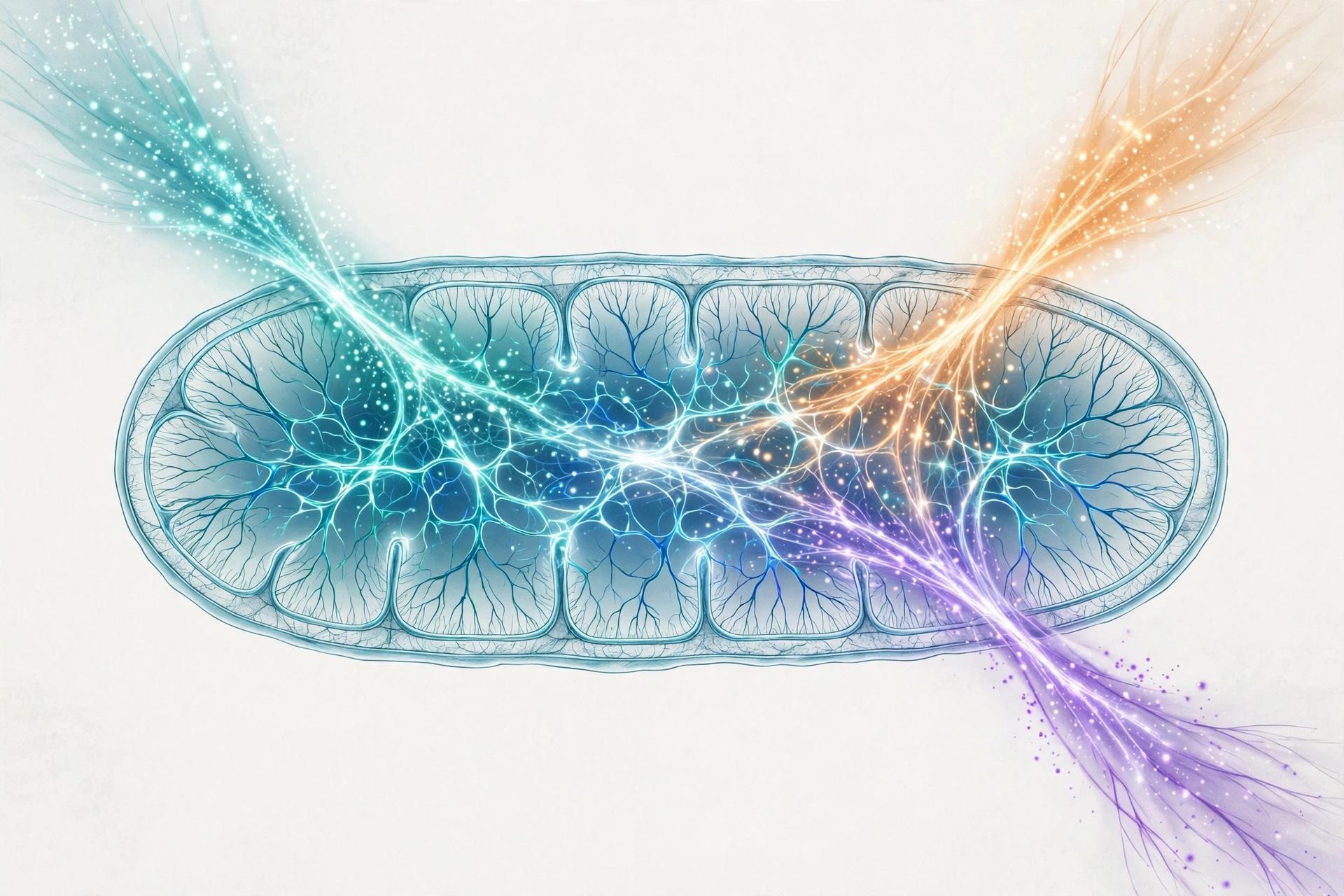
Mito Blend is a 120MG research blend of three metabolic research compounds: NAD+ at 100MG, MOTS-C at 10MG, and 5-Amino-1MQ at 10MG. Only one of the three is a peptide. MOTS-C is a 16-amino-acid peptide, NAD+ is a coenzyme nucleotide, and 5-Amino-1MQ is a small molecule, so the blend is catalogued with peptide research materials because of the metabolic questions the three are studied for, not because all three share one chemistry.
One limit needs to be stated at the start. The blend itself has no published study. No laboratory has published a peer-reviewed experiment on this three-component combination, so every finding reviewed here comes from single-component literature. This guide reviews what each component is, what that separate evidence shows, and how laboratories verify a blended material.
What Is Mito Blend, Exactly?
Mito Blend is a fixed-composition research material. The label states the total and the parts together, so a researcher can see exactly which share of the 120MG belongs to each component.
- Product name: Mito Blend 120MG
- NAD+: 100MG — nicotinamide adenine dinucleotide, a dinucleotide coenzyme
- MOTS-C: 10MG — a 16-amino-acid mitochondrial-derived peptide
- 5-Amino-1MQ: 10MG — 5-amino-1-methylquinolinium, a small-molecule enzyme inhibitor
- Total: 120MG
- Shared research theme: Cellular energy metabolism and NAD+ biology
That mixture of classes is the defining feature of the blend. A peptide, a nucleotide coenzyme, and a quinolinium small molecule behave differently in solution and are confirmed by different analytical checks, so a laboratory has to verify three identities, not one.
What Is NAD+ and Why Is It Studied?
NAD+ is nicotinamide adenine dinucleotide in its oxidised form, CAS 53-84-9. It is a dinucleotide: two nucleotides joined through their phosphate groups, one carrying adenine and the other carrying nicotinamide. It contains no amino acids, and it is present in every living cell as a central coenzyme of energy metabolism.
In its redox role, NAD+ accepts electrons in central metabolic reactions and is regenerated as NADH delivers those electrons onward, so the NAD+ to NADH ratio tracks the redox state of the cell compartment. Alongside that cycling role sits a second role, in which the molecule is consumed rather than recycled.
Citation: Yang Y, Sauve AA. NAD(+) metabolism: Bioenergetics, signaling and manipulation for therapy. Biochimica et Biophysica Acta. 2016. [PubMed PMID: 27374990](https://pubmed.ncbi.nlm.nih.gov/27374990/)
Three enzyme families consume NAD+ as a substrate. Sirtuins use it to remove acyl groups from proteins. Poly(ADP-ribose) polymerases, the PARPs, use it to build ADP-ribose chains during the DNA damage response. CD38, a membrane NADase, hydrolyses it and generates calcium-mobilising messengers.
A widely cited mouse study reported that CD38 expression and activity rise with age, that CD38 was required for the age-related decline in tissue NAD+ in that model, and that the effect ran in part through the mitochondrial sirtuin SIRT3. That is one reason NAD+ supply, consumption, and mitochondrial function are studied as one connected system.
Citation: Camacho-Pereira J, et al. CD38 Dictates Age-Related NAD Decline and Mitochondrial Dysfunction through an SIRT3-Dependent Mechanism. Cell Metabolism. 2016. [PubMed PMID: 27304511](https://pubmed.ncbi.nlm.nih.gov/27304511/)
For a fuller review, see the NUPEPS PEPTIDES guide to NAD+ research.
What Is MOTS-C and Where Does It Come From?
MOTS-C is the peptide in the blend, and it is an unusual one. It is a 16-amino-acid peptide encoded not in nuclear DNA but inside the mitochondrial genome, in a short open reading frame within the mitochondrial 12S rRNA gene — the origin its full name records.
Lee and colleagues reported MOTS-C in 2015, showing that the small open reading frame is translated and that the peptide regulates metabolic homeostasis in the models studied. In cell work, MOTS-C acted on the folate-methionine cycle and de novo purine synthesis, raising the intermediate AICAR, which activated AMP-activated protein kinase, AMPK.
Citation: Lee C, et al. The Mitochondrial-Derived Peptide MOTS-c Promotes Metabolic Homeostasis and Reduces Obesity and Insulin Resistance. Cell Metabolism. 2015. [PubMed PMID: 25738459](https://pubmed.ncbi.nlm.nih.gov/25738459/)
In the same study, MOTS-C administration in mice was associated with protection against age-dependent and diet-induced insulin resistance and obesity in those models. Later work has extended the mechanism, including stress-dependent movement of MOTS-C to the nucleus. No controlled human trial of MOTS-C as an intervention has been published.
For the dedicated review, see the NUPEPS PEPTIDES guide to MOTS-C research.
What Is 5-Amino-1MQ and What Does It Inhibit?
5-Amino-1MQ is 5-amino-1-methylquinolinium, a synthetic small molecule built on a methylquinolinium scaffold. It has no amino-acid sequence and no peptide bond. It was characterised as a selective, membrane-permeable inhibitor of nicotinamide N-methyltransferase, NNMT, a cytosolic enzyme that methylates nicotinamide.
NNMT matters to NAD+ biology because its reaction consumes nicotinamide, a salvage-pathway precursor of NAD+. In cultured adipocytes, the methylquinolinium inhibitors reduced intracellular 1-methylnicotinamide, increased intracellular NAD+ and S-adenosylmethionine, and suppressed lipogenesis — the mechanistic chain the class is studied for.
Citation: Neelakantan H, et al. Selective and membrane-permeable small molecule inhibitors of nicotinamide N-methyltransferase reverse high fat diet-induced obesity in mice. Biochemical Pharmacology. 2018. [PubMed PMID: 29155147](https://pubmed.ncbi.nlm.nih.gov/29155147/)
In that study, a potent inhibitor from the series reduced body weight and white adipose mass, decreased adipocyte size, and lowered plasma total cholesterol in diet-induced obese mice, with no change in food intake reported in the model. The evidence is cell and mouse work from one research programme, and no human study of 5-Amino-1MQ has been published.
For the standalone review, see the NUPEPS PEPTIDES guide to 5-Amino-1MQ research.
How Do the Three Components Compare?
| Component | Class | Primary research mechanism | Evidence type |
|---|---|---|---|
| NAD+ (100MG) | Dinucleotide coenzyme | Redox coenzyme and consumed substrate for sirtuins, PARPs and CD38 | Extensive cell and animal literature; reviews and mechanistic studies |
| MOTS-C (10MG) | Peptide, 16 amino acids | Folate-methionine cycle and AICAR-linked activation of AMPK | Discovery paper plus follow-up cell and mouse studies |
| 5-Amino-1MQ (10MG) | Small molecule, methylquinolinium | Selective inhibition of NNMT, raising intracellular NAD+ in adipocyte models | Cell and diet-induced obese mouse studies |
The three rows share a metabolic neighbourhood — NAD+ availability, energy sensing through AMPK, and the NNMT reaction — but reach it by three unrelated chemistries, each resting on its own separate literature.
Why Are These Three Components Studied Alongside Each Other?
The honest answer is thematic, not experimental. The pathways intersect in the published models: NNMT inhibition raised intracellular NAD+ in adipocytes, CD38-driven NAD+ decline affected a mitochondrial sirtuin, and MOTS-C signalling converged on AMPK.
What that does not establish is synergy. No published experiment has administered this combination, measured an interaction between the components, or compared the blend against its parts. Any claim that the three amplify each other would be an invention, and this guide makes no such claim. The record a laboratory can rely on remains the single-component record for each part.
What Does the Published Evidence Actually Show?
Read as three separate records, the evidence is uneven in an informative way. NAD+ biology is deep and settled at its core: the redox role, biosynthetic pathways, and consuming enzymes are textbook material, even though questions about supplying the molecule from outside a cell rest mainly on cell and animal studies.
MOTS-C and 5-Amino-1MQ sit at the opposite end of maturity. Each has a clear, published mechanism and a small, concentrated literature, and neither has a published controlled human trial or supports conclusions beyond its cell and animal models.
For the blend, the evidence statement is shorter still: there is none at the level of the combination. Any experiment using it is exploratory work whose results would themselves be the first data on the combination.
How Is Mito Blend Used in Laboratory Research Today?
Within those boundaries, the research questions a laboratory can design around the material follow from the three component literatures:
- NAD+ pool studies: models examining NAD+ availability, consumption by sirtuins, PARPs and CD38, and salvage-pathway flux.
- Energy-sensing studies: cell systems built around AMPK activation and the pathways MOTS-C is reported to engage.
- NNMT studies: adipocyte models examining NNMT inhibition, 1-methylnicotinamide levels, and lipogenesis readouts.
- Comparative blend studies: exploratory designs running the blend alongside its individual components, checked against single-component baselines.
The last role deserves emphasis. Because no published baseline exists for the combination, a careful design treats the individual components as the controls; an observation made with the blend alone cannot be attributed to any one component.
How Do Researchers Verify Mito Blend Material?
Verification of a blend is component-by-component work. Mass spectrometry and chromatographic methods such as reversed-phase HPLC confirm identity and quantify material, and the analytical record has to account for a peptide, a nucleotide, and a small molecule that differ sharply in mass and behaviour.
Researchers therefore look for a batch-specific Certificate of Analysis for the exact batch supplied. NUPEPS PEPTIDES publishes batch Certificates of Analysis, available at nupeps.com/coas, and tests every batch for purity, quantity, and sterility. The certificate ties the labelled composition to the material actually in hand.
Mito Blend Research Material at NUPEPS PEPTIDES
NUPEPS PEPTIDES supplies Mito Blend as a lyophilised research material, Mito Blend 120MG, for laboratory and in vitro research use only. Each batch is accompanied by its Certificate of Analysis, so the material can be matched to its analytical record before use in an experiment. It is not a drug, and it is not for human or veterinary use.
Frequently Asked Questions
What is Mito Blend in simple terms?
Mito Blend is a 120MG research blend of three metabolic compounds: NAD+ at 100MG, the peptide MOTS-C at 10MG, and the small molecule 5-Amino-1MQ at 10MG. It groups three entry points into NAD+ and energy-sensing research in one material, for laboratory and in vitro research only.
Is Mito Blend a peptide?
Only in part. MOTS-C is a 16-amino-acid peptide. NAD+ is a dinucleotide coenzyme with no amino acids in its structure, and 5-Amino-1MQ is a methylquinolinium small molecule. The blend is catalogued with peptide research materials because all three are studied in the same metabolic research area.
Has Mito Blend itself been studied?
No. No peer-reviewed study of this three-component combination has been published. Everything known about its parts comes from single-component research, in which each compound was studied separately, mostly in cell and animal models.
What is the difference between NAD+ and 5-Amino-1MQ in the blend?
They act at opposite sides of the same pool in the models studied. NAD+ is the coenzyme itself, consumed by sirtuins, PARPs, and CD38. 5-Amino-1MQ inhibits NNMT, an enzyme that consumes the NAD+ precursor nicotinamide, and NNMT inhibition raised intracellular NAD+ in cultured adipocytes.
How can a researcher check Mito Blend quality before an experiment?
Ask for the batch-specific Certificate of Analysis and check that the record accounts for all three components of the exact batch supplied, rather than relying on a generic specification sheet. NUPEPS PEPTIDES publishes its batch certificates at nupeps.com/coas, and every batch is tested for purity, quantity, and sterility.
Conclusion
Mito Blend is best understood as three well-defined research compounds sharing one metabolic neighbourhood: a coenzyme at the centre of redox and signalling biology, a mitochondrial peptide that engages energy sensing through AMPK, and a small molecule that inhibits an enzyme drawing on the NAD+ precursor pool.
The same honesty also sets the boundary: the combination itself is unstudied in the published record, and no synergy claim survives that fact. For laboratories sourcing the blend today, the standard is documentation — a batch-specific Certificate of Analysis covering all three components, from material tested for purity, quantity, and sterility. This article is educational material and is not medical advice.
Frequently asked questions
Is What Is Mito Blend? NAD+, MOTS-C and 5-Amino-1MQ Guide for human use?
No. All compounds discussed in this guide are strictly for laboratory research use only. Not for human or veterinary use.
Where can I find the Certificate of Analysis?
Certificates of Analysis are available in our COA library. Each batch is third-party tested for purity and identity.
How should research compounds be stored?
Store according to the vial label instructions. Generally, lyophilized compounds should be kept in a cool, dry place away from light. Refer to the specific product documentation for details.
All products are intended strictly for laboratory research and in-vitro use only. Not for human or veterinary consumption, diagnostic, or therapeutic use. Products are not drugs, foods, cosmetics, or dietary supplements and may not be misbranded, misused, or mislabeled.